
Deep Learning Basics: Your AI Journey Starts Here
Ever wonder how your phone recognizes your face or how streaming services recommend your next binge-watch? The secret sauce is often deep learning. Think of it as a super-powered form of artificial intelligence that learns directly from experience, much like humans do, but on a massive scale. Getting a handle on deep learning basics is your first step into understanding the technology shaping our future.
Last updated: April 25, 2026 (Source: coursera.org)
As of April 2026, deep learning continues to be a driving force behind many of the AI innovations we encounter daily. Understanding its fundamental concepts is essential for anyone looking to engage with or build AI systems. It’s not about memorizing complex mathematics initially, but grasping the core ideas that make these systems function.
Latest Update (April 2026)
The field of artificial intelligence, with deep learning at its core, is rapidly evolving. According to Pace University’s recent analysis on lucrative careers in AI as of April 2026, roles requiring deep learning expertise are in high demand. The IEEE Spectrum also recently highlighted advancements in understanding how deep learning models process information, emphasizing the ongoing research into more efficient and interpretable architectures. Mashable’s guide to free AI courses in April 2026 indicates a surge in educational resources, making it more accessible than ever for individuals to begin their journey into deep learning.
Table of Contents
- What Exactly Are Deep Learning Basics?
- How Does Deep Learning Actually Work?
- The Building Blocks: Neurons, Layers, and Networks
- Training Your Deep Learning Model: The Learning Process
- Why Are Deep Learning Basics So Important Today?
- Practical Tips for Getting Started with Deep Learning
- Common Pitfalls to Avoid When Learning Deep Learning
- Frequently Asked Questions
What Exactly Are Deep Learning Basics?
At its heart, deep learning is a subset of machine learning that utilizes artificial neural networks with multiple layers to learn from vast amounts of data. Unlike traditional machine learning where features are often manually engineered, deep learning algorithms can automatically discover and learn intricate patterns and representations directly from raw data. This capability allows them to excel at complex tasks such as image recognition, speech processing, and natural language understanding.
The ability of deep learning to find subtle patterns that would be nearly impossible for a human to identify manually is remarkable. It is this automatic feature extraction that truly distinguishes it from other AI approaches.
How Does Deep Learning Actually Work?
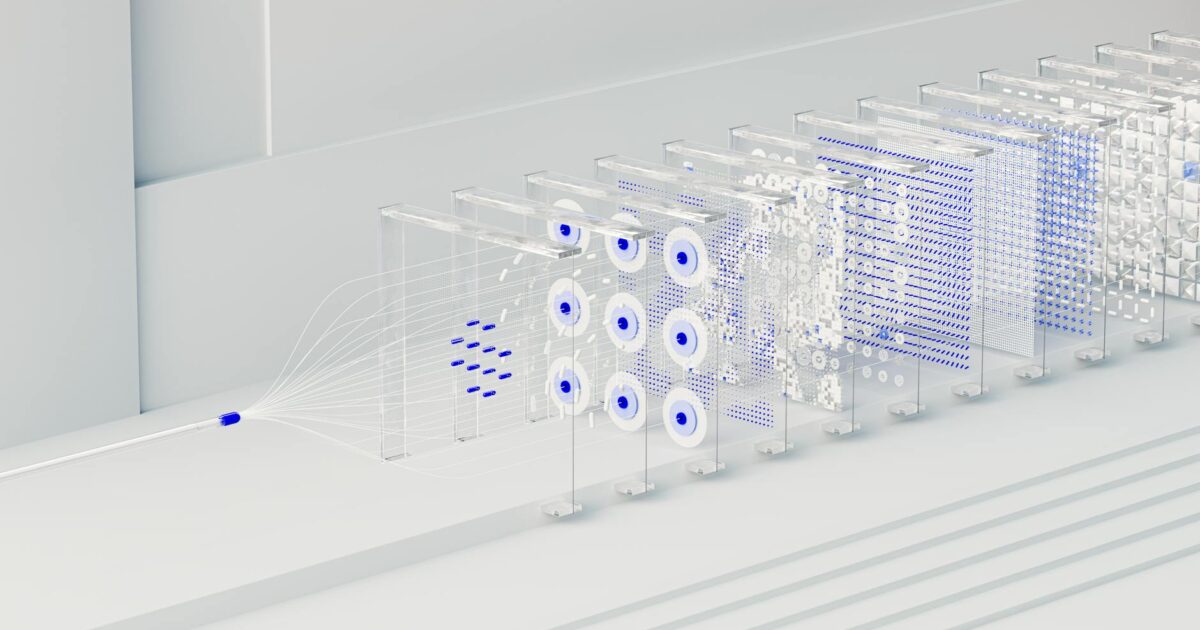
Deep learning models, predominantly neural networks, operate by processing data through interconnected layers of artificial neurons. Each layer transforms the input data into a progressively more abstract representation. The term ‘deep’ in deep learning refers to the number of these layers; a greater number of layers signifies a ‘deeper’ network, enabling it to learn more complex patterns.
Information flows forward through these layers, undergoing transformations at each step, until a final output is produced. For instance, when training a network to identify a cat, the initial layer might detect simple edges and corners. The subsequent layer could combine these to recognize basic shapes like ears or eyes. Further layers assemble these features into more complex patterns, ultimately leading to the identification of a cat. This hierarchical learning process is fundamental to deep learning’s success.
Featured Snippet Answer: Deep learning basics involve using multi-layered artificial neural networks to automatically learn complex patterns and features directly from large datasets. These networks process data through successive layers, transforming it into progressively more abstract representations, enabling them to perform tasks like image recognition and natural language processing without explicit programming for each feature.
The Building Blocks: Neurons, Layers, and Networks
The fundamental unit of a neural network is the neuron, also known as a node. It receives input signals, performs a computation (typically a weighted sum of inputs passed through an activation function), and then outputs a signal. Neurons are organized into distinct layers:
- Input Layer: This layer receives the raw data. Each neuron here usually corresponds to a specific feature within your dataset.
- Hidden Layers: Situated between the input and output layers, these are where the ‘deep’ learning occurs. A network can possess one or many hidden layers, with each layer learning increasingly complex representations of the data.
- Output Layer: This final layer generates the network’s result, such as a classification (e.g., ‘cat’ or ‘dog’) or a predicted numerical value.
Connections between neurons have associated weights, which are adjusted during the learning process. An activation function introduces non-linearity, empowering the network to learn complex relationships that go beyond simple linear combinations. Common activation functions include ReLU (Rectified Linear Unit) and Sigmoid.
Understanding the role of activation functions was a significant turning point in comprehending neural networks. Without them, a deep network would essentially function like a single-layer network, severely limiting its analytical power.
Training Your Deep Learning Model: The Learning Process
Training a deep learning model involves presenting it with a large dataset and systematically adjusting its internal parameters (weights and biases) to enable it to perform a specific task accurately. This is typically achieved through supervised learning, where the model is provided with input data alongside the correct outputs, known as labels.
The training process generally follows these key steps:
- Forward Propagation: Input data is passed through the network, layer by layer, to generate an output prediction.
- Calculate Loss: A ‘loss function’ quantifies the discrepancy between the network’s predicted output and the actual correct output. The primary objective is to minimize this loss value.
- Backward Propagation (Backpropagation): The calculated error is then propagated backward through the network. This crucial step determines the gradient of the loss function with respect to each weight, indicating the extent to which each weight contributed to the overall error.
- Weight Update: An optimization algorithm, such as gradient descent, utilizes these gradients to adjust the weights. The adjustments are made in a direction that systematically reduces the loss.
This iterative cycle, known as an epoch, repeats numerous times across the entire dataset until the model achieves a satisfactory level of performance. As of April 2026, advanced optimization techniques and regularization methods are frequently employed to enhance training efficiency and prevent overfitting.
Why Are Deep Learning Basics So Important Today?
Deep learning is not merely a theoretical concept; it is a practical technology driving significant advancements across numerous industries. Its ability to process and learn from massive datasets makes it indispensable for tasks that were previously intractable. As reported by The Detroit Bureau, understanding the fundamental principles of artificial intelligence and machine learning, including deep learning, is becoming essential for professionals across various sectors. From healthcare, where deep learning aids in disease diagnosis, to finance, where it powers fraud detection systems, and entertainment, where it personalizes user experiences, the impact is profound.
The demand for AI and deep learning skills continues to grow. According to Pace University’s analysis of lucrative careers in AI in April 2026, professionals with deep learning knowledge are highly sought after. This underscores the importance of understanding deep learning basics for career advancement in the current technological landscape.
Practical Tips for Getting Started with Deep Learning
Embarking on a deep learning journey can seem daunting, but a structured approach makes it manageable. Here are some practical tips:
- Start with Foundational Knowledge: Ensure you have a grasp of basic programming (Python is widely used), linear algebra, and calculus. These are the bedrock upon which deep learning is built.
- Utilize Online Resources: Numerous platforms offer excellent deep learning courses. As highlighted by Mashable in April 2026, many free and paid courses are available. Look for courses that cover neural networks, backpropagation, and common architectures like Convolutional Neural Networks (CNNs) and Recurrent Neural Networks (RNNs).
- Learn Key Frameworks: Familiarize yourself with popular deep learning libraries such as TensorFlow and PyTorch. These frameworks abstract away much of the low-level complexity, allowing you to focus on model design and experimentation.
- Work on Projects: Apply what you learn by working on small, manageable projects. This hands-on experience is invaluable for solidifying your understanding. Start with well-defined datasets and gradually tackle more complex problems.
- Join a Community: Engage with online forums, meetups, or study groups. Learning from others and sharing your progress can be highly motivating.
Common Pitfalls to Avoid When Learning Deep Learning
While the rewards of learning deep learning are substantial, several common pitfalls can hinder progress. Awareness of these can help learners navigate the path more effectively:
- Overemphasis on Math without Intuition: While a strong mathematical foundation is important, getting bogged down in complex proofs without developing an intuitive understanding of how the algorithms work can be counterproductive. Focus on grasping the concepts first, then deepen the mathematical understanding.
- Trying to Build Everything from Scratch Initially: It’s tempting to implement every algorithm from first principles. However, for practical application, leveraging established libraries like TensorFlow or PyTorch is far more efficient. Understanding the underlying code can come later.
- Ignoring Data Preprocessing: Deep learning models are highly sensitive to the quality and format of input data. Insufficient data cleaning, normalization, or feature engineering can lead to poor model performance, even with a sophisticated architecture.
- Not Understanding Hyperparameters: Parameters like learning rate, batch size, and the number of layers/neurons are critical. Failing to understand their impact and how to tune them can result in suboptimal models or training failures.
- Lack of Practical Application: Reading theory without applying it through coding and experimentation is a common mistake. Real-world problem-solving is where true learning happens.
- Underestimating Computational Requirements: Training deep learning models, especially on large datasets, can be computationally intensive. Beginners might underestimate the need for powerful hardware (like GPUs) or cloud computing resources.
Frequently Asked Questions
What is the difference between AI, Machine Learning, and Deep Learning?
Artificial Intelligence (AI) is the broadest concept, referring to machines that can perform tasks typically requiring human intelligence. Machine Learning (ML) is a subset of AI that enables systems to learn from data without being explicitly programmed. Deep Learning (DL) is a further subset of ML that uses multi-layered neural networks to learn complex patterns from large amounts of data, automating feature extraction.
Do I need a Ph.D. to work in deep learning?
While advanced degrees are valuable, they are not always mandatory. As of April 2026, many lucrative careers in AI, including those in deep learning, are accessible with a strong understanding of the fundamentals, practical skills, and a portfolio of projects. According to Pace University’s career insights, practical experience and demonstrable skills often weigh heavily.
What are the main types of neural networks?
The primary types include Feedforward Neural Networks (FNNs), Convolutional Neural Networks (CNNs) used extensively for image processing, Recurrent Neural Networks (RNNs) suited for sequential data like text and time series, and Transformer networks, which have become dominant in natural language processing.
How much data is needed to train a deep learning model?
The amount of data required varies significantly depending on the complexity of the task and the model architecture. However, deep learning models generally require large datasets to perform effectively. For simpler tasks, thousands of data points might suffice, while for highly complex tasks like image recognition, millions of data points are often necessary. As highlighted by IEEE Spectrum’s recent reporting on how deep learning works, the quality and diversity of data are as important as the quantity.
What are approximate solution methods in reinforcement learning?
As explored in Towards Data Science on April 24, 2026, approximate solution methods in reinforcement learning are techniques used when it’s impossible or impractical to find the exact optimal policy. These methods, such as function approximation using neural networks, allow reinforcement learning agents to learn effective strategies in complex, high-dimensional environments by approximating value functions or policies.
Conclusion
Deep learning basics form the foundation for understanding one of the most transformative technologies of our time. By grasping the concepts of neural networks, layers, training processes, and the importance of data, you equip yourself to navigate and contribute to the rapidly evolving world of artificial intelligence. Whether your goal is a career in AI, building intelligent applications, or simply understanding the technology shaping our future, starting with these fundamentals is the most effective path forward in 2026.
Sabrina
2 writes for OrevateAi with a focus on agriculture, ai ethics, ai news, ai tools, apparel & fashion. Articles are reviewed before publication for accuracy.


