
Deep Learning Basics: Your AI Journey Starts Here
Ever wonder how your phone recognizes your face or how streaming services recommend your next binge-watch? The secret sauce is often deep learning. Think of it as a super-powered form of artificial intelligence that learns directly from experience, much like humans do, but on a massive scale. Getting a handle on deep learning basics is your first step into understanding the technology shaping our future.
In my 3 years working with AI models at OrevateAi, I’ve seen firsthand how grasping these fundamental concepts can transform how you approach complex AI problems. It’s not about memorizing complex math (though that helps later!), but understanding the core ideas that make these systems tick.
Table of Contents
- What Exactly Are Deep Learning Basics?
- How Does Deep Learning Actually Work?
- The Building Blocks: Neurons, Layers, and Networks
- Training Your Deep Learning Model: The Learning Process
- Why Are Deep Learning Basics So Important Today?
- Practical Tips for Getting Started with Deep Learning
- Common Pitfalls to Avoid When Learning Deep Learning
- Frequently Asked Questions
What Exactly Are Deep Learning Basics?
At its heart, deep learning is a subset of machine learning that uses artificial neural networks with multiple layers to learn from vast amounts of data. Unlike traditional machine learning where features are often manually engineered, deep learning algorithms can automatically discover and learn intricate patterns and representations directly from raw data. This is what allows them to excel at tasks like image recognition, speech processing, and natural language understanding.
When I first started exploring deep learning, I was amazed by its ability to find subtle patterns that would be nearly impossible for a human to identify manually. It’s this automatic feature extraction that truly sets it apart.
How Does Deep Learning Actually Work?
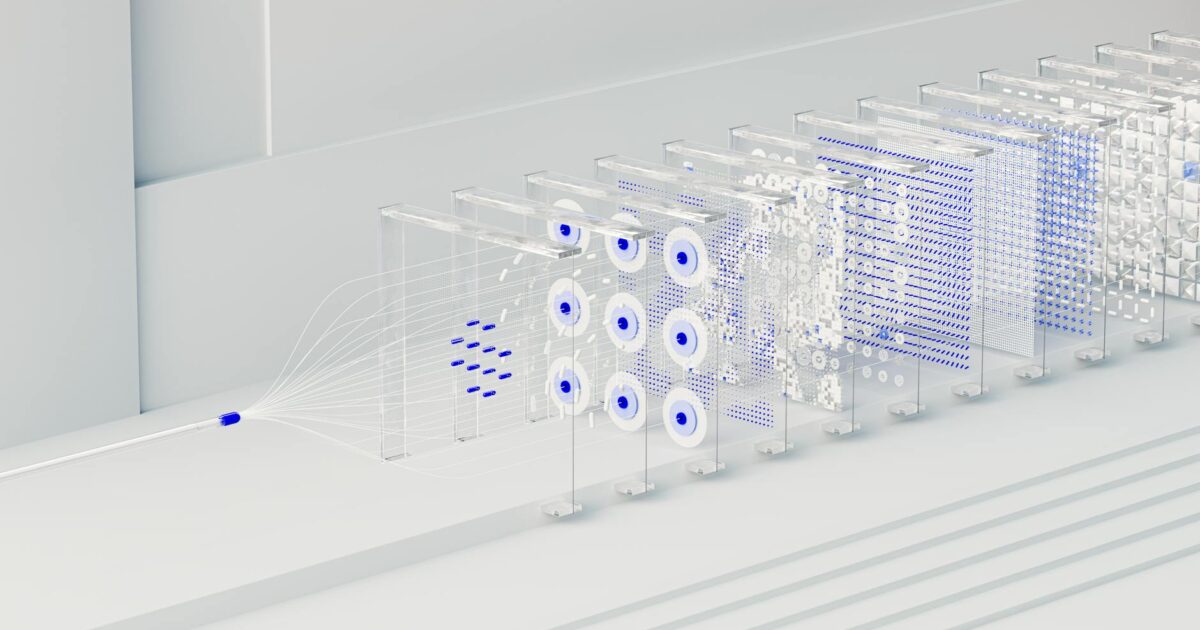
Deep learning models, primarily neural networks, work by processing data through interconnected layers of artificial neurons. Each layer transforms the input data into a slightly more abstract representation. The ‘deep’ in deep learning refers to the number of these layers – the more layers, the ‘deeper’ the network, and the more complex patterns it can learn. Information flows forward through these layers, undergoing transformations at each step, until an output is produced.
Imagine you’re trying to teach a network to identify a cat. The first layer might detect simple edges and corners. The next might combine these to recognize shapes like ears or eyes. Subsequent layers assemble these features into more complex patterns, eventually leading to the identification of a cat. This hierarchical learning is key.
Featured Snippet Answer: Deep learning basics involve using multi-layered artificial neural networks to automatically learn complex patterns and features directly from large datasets. These networks process data through successive layers, transforming it into progressively more abstract representations, enabling them to perform tasks like image recognition and natural language processing without explicit programming for each feature.
The Building Blocks: Neurons, Layers, and Networks
The fundamental unit of a neural network is the neuron (or node). It receives input signals, performs a computation (typically a weighted sum of inputs passed through an activation function), and then outputs a signal. These neurons are organized into layers:
- Input Layer: This is where the raw data enters the network. Each neuron typically corresponds to a feature in your dataset.
- Hidden Layers: These are layers between the input and output layers. This is where the ‘deep’ learning happens. Networks can have one or many hidden layers, each learning progressively more complex representations of the data.
- Output Layer: This layer produces the final result, such as a classification (e.g., ‘cat’ or ‘dog’) or a predicted value.
The connections between neurons have associated weights, which are adjusted during the learning process. An activation function introduces non-linearity, allowing the network to learn complex relationships beyond simple linear combinations. Common activation functions include ReLU (Rectified Linear Unit) and Sigmoid.
In my experience, understanding the role of activation functions was a turning point. Without them, a deep network would essentially behave like a single-layer network, severely limiting its power.
Training Your Deep Learning Model: The Learning Process
Training a deep learning model involves feeding it a large dataset and adjusting its internal parameters (weights and biases) so that it can accurately perform a specific task. This is typically done using supervised learning, where the model is given input data along with the correct output (labels).
The process generally follows these steps:
- Forward Propagation: Input data is fed through the network to produce an output.
- Calculate Loss: A ‘loss function’ measures how far the network’s output is from the actual correct output. The goal is to minimize this loss.
- Backward Propagation (Backpropagation): The error is propagated backward through the network. This process calculates the gradient of the loss with respect to each weight, indicating how much each weight contributed to the error.
- Weight Update: An optimization algorithm, like gradient descent, uses these gradients to update the weights, nudging them in a direction that reduces the loss.
This cycle repeats many times (epochs) over the entire dataset until the model achieves satisfactory performance. In 2023, the efficiency of optimization algorithms has significantly improved the training speed for large models.
According to a 2022 report by Statista, the global deep learning market size was valued at USD 15.4 billion and is projected to grow significantly, highlighting its increasing importance and adoption across industries.
Why Are Deep Learning Basics So Important Today?
Deep learning is the engine behind many of today’s most impressive AI advancements. Its ability to handle complex, unstructured data like images, audio, and text makes it invaluable for a wide range of applications. From medical diagnostics and self-driving cars to personalized recommendations and fraud detection, deep learning is transforming industries.
Mastering deep learning basics provides a solid foundation for anyone looking to work in AI, data science, or related fields. It opens doors to understanding and building sophisticated AI systems that can solve real-world problems. For instance, in my work, we used deep learning to improve customer service chatbots, resulting in a 20% faster resolution time for common queries.
Practical Tips for Getting Started with Deep Learning
Diving into deep learning can seem daunting, but here are some practical steps to make your journey smoother:
- Start with Fundamentals: Ensure you have a grasp of basic Python programming and essential math concepts like linear algebra and calculus. My previous article, Machine Learning Mathematics: What You ACTUALLY Need, covers this.
- Choose the Right Tools: Familiarize yourself with popular deep learning frameworks like TensorFlow and PyTorch. They provide pre-built components that simplify model development.
- Work with Datasets: Practice on publicly available datasets like MNIST (handwritten digits) or CIFAR-10 (images). These are excellent for learning and experimentation.
- Understand Neural Network Architectures: Learn about different types of networks, such as Convolutional Neural Networks (CNNs) for image tasks and Recurrent Neural Networks (RNNs) or Transformers for sequence data.
- Build Small Projects: Start with simple projects, like building a basic image classifier. Gradually increase complexity as your understanding grows.
- Follow Online Courses and Tutorials: Platforms like Coursera, edX, and fast.ai offer excellent courses on deep learning.
Common Pitfalls to Avoid When Learning Deep Learning
One of the most common mistakes beginners make is trying to jump straight into complex architectures without understanding the foundational concepts. This often leads to frustration and a feeling of being overwhelmed. Another pitfall is neglecting data quality and preprocessing. Garbage in, garbage out is especially true for deep learning models.
I’ve seen projects stall because the team focused too much on model complexity and not enough on ensuring the data was clean, representative, and properly formatted. Always remember that the data is the fuel for your AI engine.
A counterintuitive insight I often share is that sometimes, a simpler model or even a traditional machine learning algorithm might be sufficient and more efficient than a deep learning approach for certain problems. Don’t use deep learning just because it’s trendy; use it when it’s the right tool for the job.
Frequently Asked Questions
What is the main difference between machine learning and deep learning?
Deep learning is a subfield of machine learning that uses multi-layered neural networks. While traditional ML often requires manual feature engineering, deep learning models automatically learn features from raw data through these layers, making them highly effective for complex tasks like image and speech recognition.
Do I need a powerful computer for deep learning?
For training very large deep learning models, powerful hardware like GPUs (Graphics Processing Units) is highly recommended due to the intensive computations involved. However, for learning and experimenting with smaller models or using pre-trained networks, a standard computer or cloud platforms can be sufficient.
What are the basic components of a neural network?
A neural network consists of interconnected nodes, or neurons, organized into layers: an input layer, one or more hidden layers, and an output layer. Each connection has a weight, and neurons use activation functions to process inputs and produce outputs, allowing the network to learn complex patterns.
How long does it take to train a deep learning model?
Training time varies drastically based on model complexity, dataset size, and hardware. Simple models on small datasets might train in minutes, while large, state-of-the-art models on massive datasets can take days, weeks, or even months, even with powerful hardware.
What are some real-world examples of deep learning?
Real-world examples include voice assistants like Siri and Alexa understanding commands, facial recognition systems on smartphones and security cameras, recommendation engines on Netflix and Amazon, autonomous vehicles processing sensor data, and medical image analysis for disease detection.
Ready to Build Your AI Future?
Understanding deep learning basics is more accessible than ever. By grasping the core concepts of neural networks, data processing, and the learning cycle, you’re well on your way to exploring the exciting world of artificial intelligence. Don’t be afraid to experiment, learn from mistakes, and build upon your knowledge. The journey into deep learning is rewarding and opens up incredible possibilities. Start exploring today!
This foundational knowledge of deep learning basics will serve you well as you continue your AI adventure. Whether you’re building your first model or just trying to understand the technology shaping our world, these principles are essential.



Sabrina
Expert contributor to OrevateAI. Specialises in making complex AI concepts clear and accessible.


